

.svg)
Many of us were taught to think of career development as a ladder. Employees climb ever higher through the ranks, kind of like Godzilla scaling a skyscraper.
But the modern career journey is more like a lattice than a ladder. Instead of Godzilla, imagine a game of Donkey Kong. There are plenty of rungs to climb, but also platforms that let you move horizontally and diagonally. You might even find a rope for swinging into new territory—all within the same game. This zigzagging network of interconnected routes is the idea behind a career lattice.
Growth remains an important factor in job satisfaction—63% of workers say they’ve quit a job due to lack of advancement opportunities. But today's employees seek growth in multiple directions, not just upward.

From linear to multi-directional: What is a career lattice?
A career lattice is a framework that lets employees move up, sideways, or diagonally within an organization—like routes on a climbing wall. This approach encourages free flow of information, shared decision-making, and a less rigid hierarchy.
The career lattice model supports internal mobility by offering various paths for growth. In this environment, employees can gain new skills and experiences without leaving the company. Moves along a career lattice might look like:
- Taking on a new role within the same department.
- Switching to a new department that aligns with different skills or interests while remaining at the same level.
- Advancing to a higher position within the same department or location.
- Staying in the same role while transferring to a new branch, city, or office location.
Career ladder vs career lattice
The corporate lattice concept is not new. In the 1950s, Bill Gore and his company, W.L. Gore & Associates—known for Gore-Tex—introduced the term "lattice" to describe their decentralized, interconnected organization. More recently, companies like Sodexo, Cisco, and Thomson Reuters have embraced this career lattice approach. Yet, for decades, the corporate ladder has remained the dominant mindset.
But now success is no longer defined by steadily climbing the ranks within a single company. It’s about exploring diverse roles and experiences. Unlike the traditional one-way ladder, career lattices offer flexibility—supporting lateral moves, upskilling and reskilling, and personalized career paths.
This shift aligns with current workforce trends. According to the Bureau of Labor Statistics (BLS), American adults hold an average of 12 jobs by the time they’re 55. And with nearly half (46%) of employees considering a job change this year, the writing is on the wall—the linear career ladder no longer fits with how people view their careers.
Employers should embrace this shift by supporting diverse career paths. For HR leaders, this means offering different types of advancement opportunities.
How a career lattice benefits employees and supports company growth
People want to grow and learn new things—it’s human nature. In a 2023 American Psychological Association (APA) survey, 91% of respondents said consistent learning opportunities are important in their jobs.
Without growth, employees become bored and antsy. Many HR leaders agree, unengaged employees are more likely to have problems or quit down the road. And as Gallup found in 2023, unengaged or actively disengaged employees account for approximately $1.9 trillion in lost productivity nationally.
The career lattice fights boredom and supports employee and business advancement in a number of ways:
- Accommodates employees who prefer specialist roles over leadership positions
- Allows people to explore and use a broader range of skills
- Offers customized options for growth and development
- Keeps teams engaged as they explore new challenges
- Creates more versatile, well-rounded, and change adaptive teams
- Provides alternatives to leaving for employees seeking new experiences
- Encourages cross-functionality, collaboration, and knowledge sharing
- Helps you address talent shortages more effectively
Why the career lattice matters more than ever
Let’s face it, how work gets done is completely different from even a decade ago. With 39% of key skills required in the job market predicted to change by 2030, less than half of HR and L&D professionals feel like their learning and development strategy will prepare their company for future skill needs.
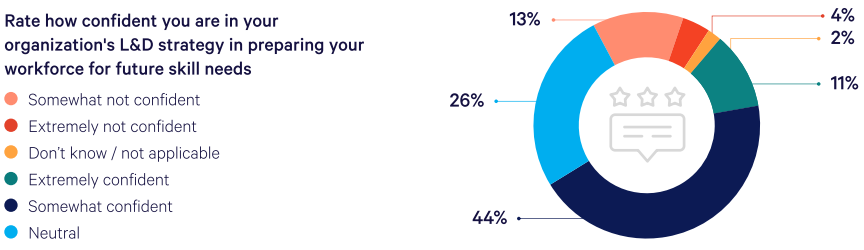
Since the career lattice is a more skills-and-potential-based framework, it creates employees with varied skills and experience, adaptability, and cross-functional fluency.
A lattice framework enables three critical capabilities that support future skill and competency needs:
- Agility in a skills-based economy: Lattices make it easier to place people where their strengths will have the greatest impact. Instead of relying on title-based progression (which is often too slow), your company can enable lateral moves that close skill gaps instantly.
- Increased career equity: Traditional ladders often give the most advantage to the people who have access to certain managers, projects, or social capital. Lattices open more pathways to advancement and move your company towards more equitable growth.
- Stronger leadership pipelines: Leadership development is the top priority for 2026, but it doesn't magically happen through promotions. Lattices allow leadership development to happen through stretch assignments, cross-functional roles, and skill-building projects—not just through upward title changes.
This shift is an opportunity to redefine career development in a way that actually aligns with how people learn and grow today.
What a career lattice looks like in practice
A common misconception is a lattice framework is a free-for-all, where employees hop around without structure. But in reality, strong lattices are highly structured—just not in a rigid, vertical way.
Here are some components well-designed career lattices typically include:
Transparent pathways
Clear documentation puts all career routes in one place. Employees see which skills are needed for each move, who to talk to, and what development steps they can take. This transparency alone can drastically improve engagement and retention.
Skills-based progression
Instead of tying movement to tenure or job title, companies map transitions to competencies. Employees can progress by demonstrating their impact, not just waiting for their turn.
Multiple development tracks
These often include:
- Leadership tracks (people leadership, program leadership)
- Expert tracks (deep technical, specialist, or craft-focused)
- Cross-functional tracks (roles that expand domain knowledge and collaboration)
- Project or gig tracks (temporary assignments that broaden experience)
Lattices can incorporate all of these, letting employees “zigzag” in ways that a traditional ladder framework simply does not allow.
Built-in support systems
To make a lattice truly functional, organizations can layer in:
- Sponsorship and mentorship programs
- Job rotation or exchange opportunities
- Peer learning groups
- Internal talent marketplaces or gig platforms
- Career coaching or performance enablement
- Skills-based learning plans
To get the wheels turning, next up are some real-life career lattice examples.
Career lattice examples “in the wild”
If you want proof that career lattices can work on a large scale, look to the successful companies that are doing it. Here are three examples of career lattices “in the wild”.
Buffer
Buffer pushes "build in public" to new heights, sharing company details like salary charts and management plans through posts on Medium and their website. The social media software company’s career framework uses a latticed approach to support flexible employee growth. At its core, the framework distinguishes between two main career tracks:
- Makers (Individual Contributors)
- Managers
This dual-track system allows employees to progress in their careers without being forced into management roles if that's not their desired path. The framework also uses a ‘Levels and Steps’ system to support vertical and lateral progression:
- Levels. Broader career stages with distinct job titles
- Steps. Incremental growth within each level. Employees receive recognition for leading or contributing to significant projects, regardless of formal role changes.
Area directors can customize the Step charts to fit specific team needs. And employees can advance multiple steps at one time based on their individual growth and impact. Buffer also shares how the Engineering team uses a mentorship program to strengthen team rapport and support career progression for non-managers.
Spotify
Spotify credits its success in talent attraction, retention, and overall growth to a culture of continuous learning. Valued at $73.65 billion, the streaming giant follows a "growth is not linear" approach to career development.
They help employees build flexible career paths through initiatives like:
- Internal mobility programs. Employees can participate in Gigs, Job Swaps, and Permanent Moves, focusing on skills rather than titles.
- Career support. Managers hold regular career mapping discussions, and career coaching and mentoring help employees build transferable skills.
- Data-driven learning. Spotify uses data to identify skill gaps and provide targeted learning opportunities.
- Cross-functional growth opportunities. Like an internal job board and Career Week to promote internal roles and cross-departmental interaction.
These initiatives work together to build a culture of continuous development.
Deloitte
Deloitte has been a leader in promoting the career lattice as a flexible alternative to the traditional career ladder. Since at least 2008, the professional services firm has used a lattice model to diversify employee growth and skill-building.
Here’s what makes their approach stand out:
- Mass Career Customization (MCC). Deloitte’s own framework lets employees shape their career paths based on their life stage and aspirations.
- Multidirectional career moves. Deloitte's model encourages lateral, diagonal, and vertical career moves, providing more flexibility than traditional upward-only progression.
- Focus on skills. Continuous growth is key, with plenty of internal opportunities to build the skills needed for the future.
- Cross-silo moves. Employees can switch between departments, making them more versatile and keeping the company agile.
What these organizations have in common
Organizations that succeed with the lattice model all share similar habits:
- They prioritize skills and potential over rigid job titles.
- They treat development as a continuous process, not an annual event.
- They offer multiple paths to impact, so people can grow without changing who they are.
- They measure internal mobility as a core performance indicator.
Above all, they embrace the reality that modern careers are multi-directional.
The biggest myths about lattices and the realities
Starting the shift to a lattice model can trigger some misconceptions. Here are three common myths that you can debunk right out of the gate:
“If we reward lateral moves, people won’t want promotions.”
Reality: lateral moves often create stronger leadership candidates. They deepen employees’ skills and broaden their perspective, making them more capable managers down the road.
“Too much movement hurts team productivity.”
Reality: Cross-functional experiences build more self-sufficient, collaborative teams—and reduce the dependency on a single “expert” who becomes a bottleneck.
“Employees will job-hop internally and create chaos.”
Reality: When guided by clear frameworks and manager support, internal mobility strengthens culture, retention, and employee loyalty.
Building a career lattice: A path to growth and engagement
Employees love career lattices because they keep work exciting, yet stable—they can change workflows and teams every few years without starting from scratch. For HR and L&D leaders, it keeps the talent pipeline flowing and contributes to happier employees.
Building a career lattice requires time, as it’s often part of a larger internal mobility program. Ideally, it becomes ingrained into the company culture, alongside continuous learning.
In practice, this can involve things like mentorship programs, job shadowing, and career mapping. No matter how it looks for your company, choose initiatives that help employees choose their own adventures and develop new skills within the company, keeping them engaged.
Our mentorship platform can support your journey, with tools to help you set up, customize, and track employee development programs. With Together, matching mentors and mentees is easy—and it’s just the beginning. Book a demo today to learn more.


.svg)