


.svg)
AI is transforming every industry, and learning and development is no exception. For those of you in HR, management, or L&D, many of your peers are already using AI in learning and development to help tailor content recommendations, automate learning content creation, create adaptive learning paths, and so much more.
While it doesn’t come without its own challenges and risks, the benefits of AI in learning and development shouldn’t be ignored.
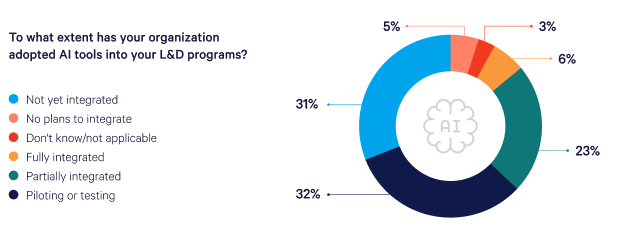
In our report Enterprise L&D in 2026: Trends and Predictions, 29% of HR and L&D professionals shared that their organization has partially or fully integrated AI into their L&D programs.
In this article, let’s explore the new role of AI in learning and development, benefits, risks, how to assess your organization’s readiness, and examples to start your brainstorm.

Why AI in employee learning and development is the next step
Now that AI has been around for a while, using AI in employee learning and development is a great place to implement the more tried-and-true applications of the tool.
As HR and L&D professionals, you already know that traditional one-size-fits-all training methods don’t account for the different needs of employees—especially if you want to promote diversity, equity, and inclusion in the workplace. But, as we’re also sure you’re acutely aware, there are only a handful of you to help train and develop hundreds if not thousands of employees—making personalized learning near impossible.
That’s where AI comes in. AI can personalize experiences based on each employee's unique needs, making talent development strategies more impactful. Using AI in learning and development is a current and future need not just to create a better learning experience for employees, but to lighten the lift for L&D teams to scale programs.
6 benefits of AI in learning and development
Joining AI and learning brings several advantages to the table that help L&D teams build impactful programs and improve outcomes for your learners.
Here’s how using AI for learning and development benefits you:
1. Identify and close skill gaps
AI can sift through a huge amount of data which can help you conduct a skills gap analysis in your organization. Whether it’s technical skills, soft skills, or role-specific competencies, AI helps pinpoint areas where training is needed the most. By accelerating talent development, you can help ensure your workforce is well-equipped to meet current and future challenges.
2. Leverage internal knowledge
Another benefit of using AI in learning and development is getting the most out of your company’s internal knowledge. AI learning and development tools can sift through documentation like product information, sales strategies, and internal policies to identify learning opportunities and create training resources. These tools also offer ways for internal SMEs to turn their expertise into training materials to share their knowledge company-wide.
3. Personalize to learner needs
AI can offer real-time support to learners, providing them with instant feedback and resources tailored to their needs. Learning and development tools that use AI can respond to queries and even anticipate what an employee might find useful. Employees all have different learning needs and AI can support that through offering different formats and feedback, making sure training is engaging and effective.
4. Harness predictive analytics
Predictive analytics capabilities allow your organization to forecast future training needs. By analyzing trends and patterns from your learning and development tools as well as external sources, AI can help predict which skills will be in demand, helping you stay ahead of the curve and prepare your employees for the future.
5. Scale L&D initiatives
Many organizations don’t have enough L&D staff to support the need for in-depth, personalized training initiatives. Using AI for learning and development allows teams to increase the amount and depth of training provided. It has the ability to automate a lot of the tedious busywork and support you in some of the more complex tasks so you and your team can focus on the most important, strategic tasks.
6. Support mentorship and social learning
Learning is fundamentally human and supporting human-centered learning is one key benefit to adopting AI in L&D. AI can help improve mentorship matching, provide agendas and discussion ideas for peer learning sessions, and help track learner progress and evolving needs—keeping mentorship programs and social learning initiatives relevant and impactful.
Potential risks and challenges of using AI in learning and development
As with any change in system or process, introducing a new tool is going to have its challenges. Understanding potential risks and issues before you dive into implementation can help you prepare and mitigate them. Let’s explore a few of the most common risks and challenges of using AI for learning and development.
Bias in AI algorithms
AI learns from the data it’s given. If that data reflects existing biases—conscious or unconscious—the tool will learn those biases, too. This can lead to things like the AI platform recommending advanced leadership courses to men more than women, or technical skills to specific demographics, reinforcing stereotypes instead of breaking them.
Here’s how to mitigate that:
- Audit your data: AI is a reflection of the data you feed it so take a hard look at your historical training and performance data. Are there patterns of inequality? Clean and balance your data where you can.
- Question your vendors: Ask for transparency from your AI tool vendors. How do they test for and mitigate bias in their algorithms? What measures are in place to ensure fairness? If it’s been trained on different data sources, what are those sources? Don’t just take their word for it either. Ask for clear evidence.
- Monitor and solicit feedback: Once implemented, continuously monitor course recommendations and completion rates across different employee groups. Create channels for employees to report instances where they feel the system is being unfair.
Over-reliance on technology
One key message that should be communicated throughout the entire process is how irreplaceable the human elements of learning are. Mentorship, coaching, and collaborative problem-solving should not and cannot be replaced by a robot. Leaning too heavily on AI tools and automated systems creates a cold, sterile, and isolated learning experience that leaves employees feeling disconnected.
Here’s how to mitigate it:
- Take a blended approach: Use AI in L&D to handle things like personalizing content recommendations or managing logistics. Reserve human instructors and mentors for high-touch activities like employee coaching, group discussions, and feedback sessions.
- Champion social learning: Humans learn best from each other. Encourage social learning by creating spaces for employees to connect at work, share knowledge, and solve problems together.
- Develop coaching skills: Equip your managers with the skills to support their team’s development. AI can suggest a course, but a manager can provide context, encouragement, and opportunities to apply new skills on the job.
Employee resistance
For many employees, AI stirs up fears of job displacement or more invasive performance monitoring. If they see AI as a threat, they won’t engage with it. You can’t force people to learn, especially when they’re skeptical of the method.
How to mitigate it:
- Communicate, communicate, communicate: Be transparent about why you’re introducing AI and how it will benefit employees directly. Frame it as a tool to help them gain new skills, advance their careers, and work smarter.
- Find champions: Find enthusiastic early adopters and allow them to become internal advocates. A testimonial from a trusted colleague is more powerful than a dozen emails from leadership.
- Start slow: Roll out AI tools to a small, willing group first. Use their success stories and feedback to build a case and demonstrate the value to the rest of the organization.
Data privacy and ethical concerns
While your IT team handles the technical side of data security, HR and L&D are the custodians of employee data. You hold the responsibility for how that data is used. Using performance or behavioral data carelessly or unethically is a swift way to erode trust. Employees need to know their information is being used to help them, not penalize them.
How to mitigate it:
- Establish a clear data ethics policy: Work with your leadership and IT teams to create and communicate guidelines for how employee data will be collected, used, and stored for L&D purposes. Make sure this policy is easily accessible.
- Prioritize anonymity: Whenever possible, use anonymized or aggregated data to identify trends without singling out individuals. For example, analyze team-wide skill gaps rather than highlighting one person’s deficiencies.
- Give employees control: Allow employees to see what data is being collected about their learning and give them some control over their data privacy settings.
Balancing risk and reward of AI in learning and development
AI brings enormous potential to learning and development—but it also requires thoughtful oversight and guardrails. The key is finding the balance between embracing all the benefits and managing the risks and challenges. Learning and understanding how to use AI in learning and development consciously and ethically will be the foundation of your future L&D programs.
The most effective approach is a human-led, AI-supported model:
How to use AI in learning and development: 7 practical examples
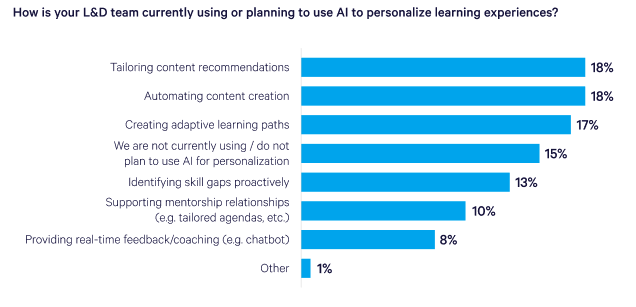
Now that we understand the benefits of using AI for learning and development—as well as the risks, challenges, and the importance of taking a blended, human-led approach—let’s explore how to use it. In our trends report, your peers told us how they already are or are planning to use AI in learning and development.
1. Personalizing learning and content recommendations
One of the clearest wins of using AI for learning and development is its ability to tailor learning experiences and content recommendations to the individual. By analyzing skill profiles, performance data, learning behaviors, and career goals, AI-powered tools can suggest logical next steps through providing resources and other learning tools.
Employees can explore these recommendations to develop new skills and continue learning—whether that’s technical skills, leadership development, or supporting their mentorship journey.
3. Streamlining content creation and curation
Using AI in learning and development offers new ways for learners, subject matter experts, and L&D professionals to create and curate material. Going beyond simple suggestions, these tools can analyze your existing training content to suggest updates, simplify complex explanations, and ensure consistency with other materials.
AI can also support multimedia creation—such as slides, videos, handouts—making it easier to transform static information into different learning formats.
3. Creating adaptive learning paths
Adaptive learning takes personalization a step further. By analyzing engagement data, mastery levels, and learning habits, AI-powered learning tools can adjust pacing, modality, and difficulty so it’s uniquely attuned to the learner.
4. Conducting skills gap analyses
AI excels at pattern recognition, making it a powerful diagnostic tool to see where learning isn’t sticking. By examining metrics such as assessment results, test scores, course completion rates, and event sentiment from learner feedback, AI can pinpoint areas where employees struggle and recommend targeted training to address these gaps.
In turn, this data helps L&D teams create more effective training programs—whether that means refreshing a module, redesigning a pathway, or introducing new formats like mentorship or microlearning. Usage and engagement data can also help you determine how to deliver certain training (self-paced? Video? Spaced repetition?) With these insights, your team can more easily track the effectiveness of your programs over time and better support future people development.
5. Supporting mentorship relationships
AI can also support more impactful mentorship relationships by analyzing participant profiles, goals, and past session notes to recommend future discussion topics or skill areas to explore.
Some AI-powered mentoring software gives mentees a “choose your own adventure”-style learning experience with recommended discussion points, resources, and conversation prompts tailored to a mentee’s development areas.
6. Providing real-time feedback
Quizzes, tests, and other kinds of assessments are incredibly useful for judging where an employee is at and what areas they need to improve on. Using AI in employee learning and development means quizzes and assessments adapt to the learner, offering a more accurate picture of capability.
Instant feedback helps learners understand where they went wrong (and right) in the moment, increasing retention and confidence.
7. Virtual coaches and tutors
While AI cannot replace the value of a mentor or coach, it can act as an always-on support—answering questions, clarifying complex topics, and suggesting resources most relevant to the learner. This is especially valuable in a remote, hybrid, or geographically-dispersed workplace where learners don’t always have quick access to a peer or mentor.
Assessing your organization’s readiness for AI in L&D
In our L&D trends report, we also talk about assessing AI readiness and why that’s such a crucial step—likening implementing AI without thorough planning to assembling furniture without reading the instructions.
While AI use at work has nearly doubled since 2023, only 22% of employees say their organization has communicated a clear plan or strategy for formally integrating AI.
So, here’s four key considerations to help you determine if your organization, your L&D team, and your employees are ready for AI in employee learning and development:
- Understand and assess any tech skills gaps on your team—including addressing AI literacy.
- Explore infrastructure and resource availability like data, current technology, budget, and people power.
- Assess cultural sentiment and readiness by feeling out how leadership feels about innovation, how employees have reacted to new systems in the past, and how employees feel about AI in general.
- Build AI literacy in the broader organization like understanding what AI can and cannot do, ethical considerations like bias and data privacy, and key terminology.
Keep all of the considerations in mind when figuring out how to use AI in learning and development and how it can apply to your organization currently and in the future.
The role of AI in learning and development: Key takeaways
From identifying skill gaps to creating richer mentorship experiences, AI has the potential to take your learning and development strategies to the next level—but only when used thoughtfully and supported by strong human oversight.These examples of AI in learning and development can complement all the great work your L&D team already does, helping you deliver more relevant, inclusive, and scalable learning experiences that truly meet learners where they are.
As with any new technology, balancing risk and reward is critical. Data privacy, ethical use, and transparency hold the utmost importance—so it’s important to research and choose AI-enabled tools that align with your company’s security and compliance standards. For example, Together’s artificial intelligence redacts all Personally Identifiable Information (PII) before processing any data and gives organizations control over enabling or disabling AI features when needed. These guardrails give L&D teams the confidence to experiment, innovate, and scale safely.
With the right foundations and governance in place, AI becomes a powerful partner to your company’s human expertise, helping you strengthen your mentorship program, supplement training courses, and create a more strategic, learner-centric learning and development strategy.
Ready to see the power of AI in L&D? Book a demo with Together and see how you can create your own human-led, AI-supported programs.


-min.jpg)


.svg)