


.svg)
Here’s a common scenario: Your company has put a lot of time and effort into hiring a new employee, but when they show up for their first day, no one was expecting them and there was no plan in place for how they’d spend their early days in their new role. Talk about a disappointing new hire experience!
But this can be avoided by taking a few proactive steps, like creating an employee onboarding journey map.
In this article, we’ll look at what employee onboarding journey maps are, why they’re important, and how to create one. Plus, we’ll share a few example templates you can use as the starting points for your own maps.

What is an employee onboarding journey map?
An employee onboarding journey map is a visual representation of what an employee experiences between the time when they accept an offer and when they are considered fully integrated into the company.
These maps generally include all the interactions, touchpoints, and milestones employees encounter during this time. They might also include ideas about what an employee is likely to be thinking or feeling.
For example, once a candidate signs an offer letter, their new manager might send them an email or call them to officially welcome them to the team. This type of interaction would typically fall into the “pre-boarding” phase (see more on the different phases below). And you might capture the employee’s thoughts or feelings as something like “They’re feeling excited about the new job and thinking about how to best prepare for their first day.”
Because onboarding is a complex and lengthy process, it’s a good idea to break it into different phases.
Different phases of onboarding to consider
Onboarding is more than a new hire’s first day or even their first week on the job. Here are a few distinct phases of onboarding to consider when thinking about what to include in your employee onboarding journey.
Pre-boarding
Pre-boarding is the period between when a candidate accepts an offer letter and when they join the company. The pre-boarding process (which often includes email, phone calls, and potentially access to a dedicated onboarding platform) aims to familiarize new employees with their role, their team members, and the organization. It can also be an opportunity to get administrative tasks out of the way so a new hire can focus on building relationships and learning more about the company culture once they officially join the company.
First days on the job
A new hire’s first days on the job are the time when you should prioritize making them feel welcome and introducing them to the people they’ll be working most closely with. These steps will likely include a mix of in-person interactions (one-on-one and group meetings), and touchpoints with members of the HR/people team, their direct manager, and team members, though there may be some training modules or work activities new hires can do on their own or as part of a cohort with others.
Job-specific training
This is when new hires get ramped up to do the job you hired them for. It might also involve learning how to use specific tools like project management software or follow processes that are unique to your company, so these steps might include a mix of in-person interactions, training modules or sessions, and solo work.
Engraining new hires into the company culture
Engraining new hires into the company culture does not necessarily need to come at the end of onboarding—it might be woven throughout the other steps. What’s important is that you think about ways you’ll introduce new hires to your company culture and make them feel welcome. This might involve meeting with the CEO or other executives in a small group setting, where they can share more about the company’s background, mission, and vision. It might also involve being paired with an onboarding buddy who can answer the new hire’s questions and provide more of an informal introduction to the company culture.
Now that we’ve covered the different phases of onboarding you might want to include in your onboarding journey map, let’s get back to a fundamental question: Why go through the process of creating an employee onboarding journey map in the first place? Because you’ll gain insights into the employee’s perspective at critical stages and reduce the chances that they’ll begin their tenure feeling slighted, undervalued, or ignored. But that’s not the only reason!
The benefits of mapping an employee onboarding journey
Mapping the employee experience in general—and specifically the onboarding portion of it—creates a consistent process that’s easier to scale as your company grows. As John Foster, former Chief People Officer at companies like IDEO, Hulu, and Truecar puts it, “I would not be able to run a people operation if I didn’t have an employee journey map.”
Here are a few reasons why it’s beneficial to map your employee onboarding journey:
- It ensures that you’re creating a welcoming experience for your new hires and not leaving it up to chance.
- It helps you identify areas for improvement in your HR processes, workplace culture, and employee engagement programs.
- It allows you to prioritize initiatives and allocate your resources effectively.
- It improves collaboration across teams and departments since it creates a clear guide to who should be doing specific tasks and when this should occur.
- It makes it easier to measure and track the impact of your employee experience initiatives.
How to create an onboarding journey map
Once you’ve decided to create an onboarding journey map, there are a few steps to go through.
Step 1: Define your goals and objectives
Just as you would for any other type of program or initiative, it’s important to start by defining your goals and objectives. What are you hoping to achieve with your onboarding journey map? Think about the impact you’re hoping to have on your business. For example, you might want to reduce turnover among new hires or accelerate their time to productivity.
Step 2: Gather information
In order to know how to fill out your onboarding journey map, you’ll need to collect information from your current and recent new hires, which you can do through one-on-one conversations or anonymous surveys. You’re looking for trends about what worked, what didn’t, and where they felt most (and least) supported.
It’s also a good idea to talk to members of your HR/People team as well as managers who have recently welcomed new team members so they can share their involvement in the onboarding experience.
If your company already conducts exit interviews, you might also find it useful to review those and see if they surface anything that could be incorporated into your onboarding program.
Step 3: Start mapping what you’ve learned
After you’ve gathered enough information to identify trends and patterns, you can start to map what you’ve learned onto your journey map. You probably already have a good idea of some of the major milestones and touchpoints to include, but you can use one of the templates below to get some ideas of what to include.
Step 4: Make sure to account for employees’ thoughts and feelings
Remember that your map should do more than document what happens at each milestone or touchpoint—it should also include some ideas about what employees are likely to be thinking and feeling at each stage. This will help you create a more empathetic experience for your new hires.
Step 5: Continue to update your map based on what you learn
You now have a first draft of your map, which is a great starting point. As you continue to collect feedback from everyone who’s involved in onboarding (especially the new hires themselves), you might identify things that are missing from your map or gaps in the actual onboarding experience that need to be filled.
Even if you’re satisfied with your employee onboarding journey map, you will probably want to revisit it from time to time to make sure it’s still accurate and make adjustments as necessary. You might decide to do this on a recurring basis, such as the beginning of a new year or any time your company hits a specific milestone, like adding a certain number of new employees or growing by a particular percentage.
5 examples of employee onboarding journey map templates
Ready to get started? Check out these employee onboarding journey map templates instead of building your own map from scratch.
Employee onboarding journey template example #1: Zendesk
Zendesk has a simple downloadable template that prompts you to fill out touchpoints, service channels, process, emotions, pain points, enablers, and next steps. You can focus on the onboarding section or you can expand to include other aspects of the employee journey such as hiring, engaging and retaining, and developing.

Employee onboarding journey template example #2: Figma
Figma offers an interactive template that prompts you to fill out information about the employee persona, journey steps, and touchpoints. They also encourage you to build upon their example by adding your own stickies, stamps, and other text. You can also invite coworkers to collaborate on your template to ensure you’re including multiple perspectives.

Employee onboarding journey template example #3: UXPressia
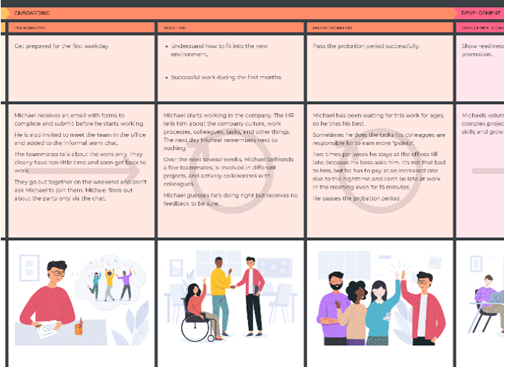
UXPressia includes several example templates on their website, but you’ll have to sign up for their customer journey mapping tool if you’d like to gain access to the full version (which is free, it just requires you to share your email address). Here’s a snippet of the end-to-end employee journey map that’s focused on the onboarding portion. They’ve also included images to illustrate what the new hire is experiencing at each stage.
Employee onboarding journey template example #4: DelveAI
DelveAI has a comprehensive employee journey template that includes several stages before and after onboarding, including recruitment, hiring, development, and retention. The template prompts you to include information about the specific employee persona and backstory as well as challenges, pain points, needs (and much more) at each stage. You’ll need to share your email address to gain access to this template.

Employee onboarding journey template example #5: Pyn
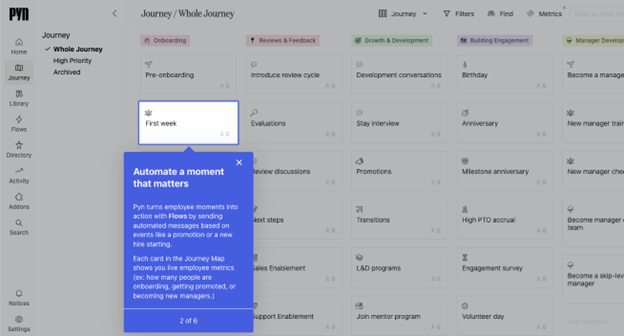
Pyn offers an interactive tool where you can build out your own employee journey. Use the format they’ve offered as your starting point and add in automations like when emails should go out to new hires. You’ll need to share your email address to gain access to this tool.
Incorporating onboarding buddies or mentors in your onboarding journey
Onboarding buddies can transform an onboarding program by creating a more personal connection between new hires and more tenured employees (often from outside their immediate team).
Whether you already have an onboarding buddy program in place or you’re just thinking of starting one, make sure you account for the touchpoints with the buddy on your onboarding journey map.
Here are a few points when it might make sense to include onboarding buddies:
- Before a new hire starts: They can get paired with an onboarding buddy who shares similar interests or background.
- On the new hire’s first day: The onboarding buddy can reach out to the new hire to set up a casual coffee meet-up and share insights into the company’s culture and resources that might be of interest to the new hire.
- During the new hire’s first few weeks: The onboarding buddy can introduce the new hire to team members from different departments, helping them understand how their role contributes to the broader company goals.
- On an ongoing basis: The onboarding buddy can share resources that contribute to the new hire’s professional development. They may even collaborate on a project or attend a professional development event together.
It’s worth noting that the new hire isn’t the only one who benefits from this arrangement: The onboarding buddy also has the opportunity to take on more of a leadership role and this experience could contribute to greater satisfaction and engagement in their role.
Beyond the employee onboarding journey map: Explore other ways to welcome new hires
Now that you have everything you need to map out the employee onboarding journey, you might be wondering what comes next. How do you actually build an onboarding experience that makes your new hires feel welcome and set up for success?
We’ve put together a detailed guide to help you create an impactful and measurable onboarding experience. It outlines the steps you’ll need to take to design, implement, and scale an effective onboarding buddy program. Download the Onboarding Mentorship Programs ebook here.
FAQs
What is an employee onboarding journey map?
An employee onboarding journey map is a visual tool that represents a new hire’s experience. It attempts to capture important moments, tasks that need to be done, and what the new hire is thinking or feeling during key moments of the journey.
Why create an employee onboarding journey map?
Creating an employee onboarding journey map helps ensure your new hire experience is consistent and easy to scale. It can also increase new hires’ satisfaction and engagement from the very beginning of their tenure with your company.
Which employee onboarding journey map template should I use?
There’s no single right answer here—you can choose whichever template you like to map your employee onboarding journey. Just be aware that some websites offer templates that are available to download as a PDF, some have interactive tools, and others require you to share your email address before providing you with a detailed version of the template.







.svg)