


.svg)
Can you predict the future? Even if that’s not a talent you naturally possess, it is one that’s often expected of you as an HR or L&D leader. You have to see where your business—and the world of work in general—is headed before everyone else does. This foresight allows you to help prepare your employees for the challenges they’re likely to face and the skills they’ll need to overcome them.
But recently it’s felt like there’s barely time to adapt to one wave of change before the next one hits. If you’re feeling knocked around by all this change and are struggling to find your footing, you’re certainly not alone.
Together is here to help. We surveyed HR and L&D leaders to better understand the current learning and development trends. What will matter most in 2026 and how can you start preparing today? We published the findings in our latest report, Enterprise L&D in 2026 Trends and Predictions. You’ll find a high-level overview here.

Trends in learning and development #1: Leadership development remains a persistent priority
The top priority for HR and L&D leaders in 2026 is leadership development and the skills that are associated with being a good leader.
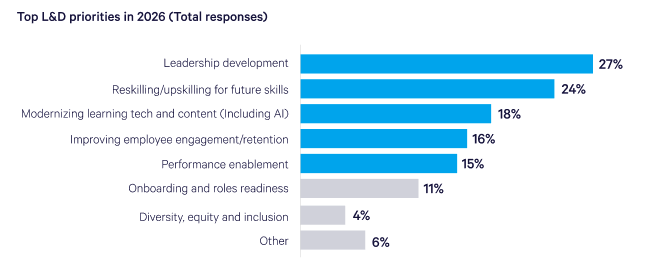
This is actually not a new trend—L&D leaders have named leadership development as a top priority for several years in a row. Yet many organizations are failing to properly train their leaders.
Why is this the case? Part of the reason is the evolution of leadership itself. The older “command-and-control” styles of management are becoming obsolete, making way for more effective and human-centric leadership.
Guiding leaders through this transition takes intentional effort and resources, which can be hard to secure. But the alternative is so much worse. A 2025 study from Gallup finds that ineffective leadership is the root of many organizational challenges. Shockingly small numbers of employees have positive things to say about their company’s leadership:
- Less than half—47% of employees—strongly agree that they know what is expected of them at work
- 31% strongly agree that someone at work encourages their development
- 32% feel strongly connected to their organization’s mission or purpose
- 28% strongly agree that their opinions count at work
All of these shortcomings are directly tied to how leadership operates—whether it’s an employee’s direct manager or the organization’s executive leadership team. If employees don’t feel supported by their leaders, they can’t perform at their best and will eventually walk out the door.
What does this mean for your L&D strategy in 2026? Addressing these gaps in leadership skills starts with a true commitment to ongoing leadership development and not just one-off workshops. Invest in targeted coaching, mentorship, and identify and nurture high-potential talent before they even step into a management role.
Trends in learning and development #2: L&D professionals feeling cautious optimism about their current strategies
According to our survey results, 11% of HR and L&D professionals feel extremely confident in their current strategies—not exactly a strong showing. However, a combined 70% are somewhat confident or neutral, signalling the majority of L&D professionals are comfortable or even cautiously optimistic about the path forward.
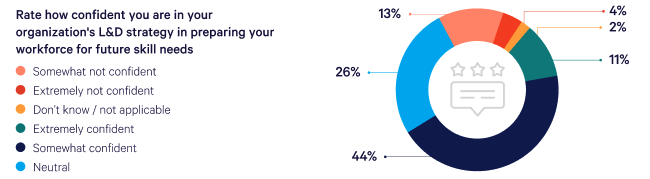
These numbers show us that there’s still plenty of room for doubt and uncertainty when it comes to L&D strategy. The area where there seems to be the greatest cause for concern is in the growing skills gap. In other words, the skills that employees have and are using today are not the ones that will lead them to succeed in the very near future. In fact, the World Economic Forum predicts that 39% of workers’ core skills will change by 2030.
Trends in learning and development #3: A shifting landscape of in-demand skills
When it comes to the specific skills employees need to develop, 56% of L&D leaders say they are leaning heavily into human-centric skills, like strategic and critical thinking. In spite of—or maybe because of—the increasing prevalence of AI technology, employees need to strengthen their ability to analyze complex situations, question assumptions, and make informed decisions.
But let’s not ignore the (artificial) elephant in the room: Digital fluency is coming in at a close second, with 44% of L&D leaders prioritizing related skills such as data literacy, AI fluency, cloud tools, and cybersecurity basics.
And don’t forget: Digital fluency (the ability to comfortably use digital tools to communicate, collaborate, solve problems, learn, and perform day-to-day job tasks) is a skill that everyone needs to develop. Even roles that typically weren’t considered technical now require these digital skills. We’re seeing that new technology is already transforming everyday tasks for workers across roles and industries. Even in L&D. For more on that topic, keep reading!
Trends in learning and development #4: AI is becoming an enabler in L&D
The power and promise of AI is already apparent within the L&D department. You and your team are no longer solely creating courses or facilitating classroom sessions—or if you are, that’s about to change. You need to learn to work alongside technology to build learning ecosystems that deliver personalized learning experiences at scale.
We were curious to learn exactly how L&D teams are harnessing the power of AI, and here’s what we heard: 61% of respondents say they have either fully integrated AI into their Learning & Development strategy, partially integrated it, or are currently in the piloting or testing phase.
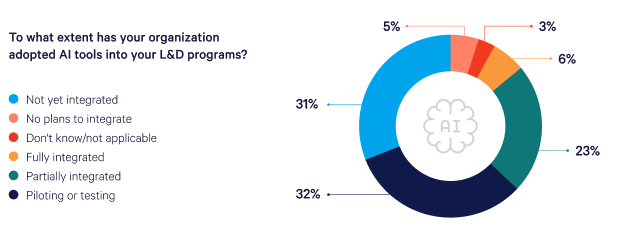
You and your team don’t need to become data scientists overnight, but a foundational level of AI literacy is required. This means understanding the core concepts, possibilities, and limitations of AI in the context of learning. Here are a few topics to explore (if you haven’t already):
- What AI can and cannot do: Spend some time differentiating between AI hype and practical applications in L&D.
- Ethical considerations: Recognize how biases can be present in AI algorithms and understand the data privacy implications of using AI tools.
- Key terminology: Know the difference between machine learning, natural language processing, and generative AI.
And in case you’re curious to hear how your L&D peers are already using or planning to use AI, they told us their main use cases are: tailoring content recommendations, automating content creation for some training materials, and creating adaptive learning paths that adjust based on employee performance and engagement.
Trends in learning and development #5: Tapping into the underutilized power of social learning
There’s strong momentum behind people-centric learning—77% of respondents believe formal mentorship will be extremely or somewhat critical to their employees’ development in 2026. However, nearly a quarter admit social learning is not leveraged effectively in their organization, citing time, leadership, lack of resources, and low employee engagement as barriers.
While hot new technology continues to take the stage, it’s important to remember what truly drives your workplace: people. Skill development and employee growth require true, human connection.
A full 77% of HR and L&D professionals believe formal mentorship programs will be somewhat or extremely critical by 2026. This number isn’t surprising, but we are concerned about the gap between intention and action.
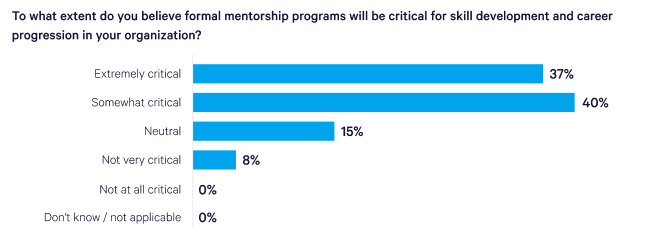
Despite so many HR and L&D professionals believing formal mentorship programs and other social learning are important, a report from Absorb found that 43.6% of organizations don’t use any kind of social learning (e.g. apprenticeships, coaching, mentorship, employee resource groups, etc.) and don’t have any plans to—marking it as a vastly underused resource. Among organizations who do use social learning as part of their L&D strategy, nearly a quarter of respondents admit their organization is leveraging it ineffectively.
Social learning is at the heart of all learning. Whether you feel your organization is leveraging it effectively or not, understanding the core pillars, benefits, and practical applications will help you continue to support your employees’ growth.
Trends in learning and development #6: The imperative to modernize learning tech & content
If you’re like most organizations, you have a library of training resources that have been in circulation for years or maybe an LMS that has been neglected for too long. Updating and modernizing learning tech and content is one of HR and L&D leaders’ highest priorities for 2026.
Whether you’re looking to completely overhaul how you deliver training and employee development initiatives or implement new technology (including AI), the phrase to keep in mind here is: change management. Nothing kills a modernization initiative like rushing implementation.
Before rolling out any new technology, spend some time assessing your organization’s AI readiness and sentiments. These questions can help:
- How open is your leadership team to AI and tech innovation and how willing are they to invest in new learning technologies?
- How have employees reacted to new systems and processes in the past?
- How do employees feel about AI? (e.g. fear they’ll be replaced by AI, excited about its potential, etc.)
Trends in learning and development #7: The shift from performance management to performance enablement
We’re beginning to see a move away from traditional performance management towards performance enablement. Changing how you approach learning, growth, and performance can have a positive impact on employees and the entire organization. How are they different? Here’s a quick snapshot.
Performance management
- Backward-looking process that focuses on evaluation
- Formal and infrequent
- Anxiety-inducing scrutiny with, “How did you do?”
Performance enablement
- Forward-looking process that focuses on development
- Continuous and collaborative
- Encourages growth and asks, “How can we help you succeed?”
The shift creates a much more positive and effective experience for everyone. It replaces judgment with coaching and annual ratings with ongoing feedback. This approach also gives employees more power to take ownership of their own growth, creating more engaged learners and more effective employees.
Putting it all together: What do these current learning and development trends mean for you?
You’ve now got a good sense of what’s on your fellow L&D leaders’ minds going into 2026. We’ve even shared a few specific questions and topics that you can explore to help you stay ahead of these trends.
Want to take a deeper dive into the data and build out your playbook for a game-changing L&D strategy in 2026? Download the report and give yourself the tools you need for staying on top of next year’s L&D trends.





.svg)