

.svg)
Running a mentorship program sounds straightforward—until demand outpaces capacity. You want to open it up to everyone, but you only have 50 mentor spots. Or your program is designed for a specific cohort, like high-potential employees or new managers, and you need a way to screen participants before they register.
That's where a mentorship application comes in. Done well, it helps you manage capacity, gather useful data, and start the program with participants who are genuinely committed. Done poorly, it creates friction and drops off.
Here's how to think about whether your program needs an application, and what questions to include when it does.
What is a mentorship application?
A mentorship application is a form that potential participants (mentors, mentees, or both) fill out to express interest in joining a program. It’s distinct from a standard registration flow, where you already know exactly who you want in the program and you’re simply collecting their information. With an application-based approach, the form itself is the registration, which means all the data you’ll need for matching (skills, goals, availability, preferences) has to be gathered upfront, in that single step.
Mentorship applications don’t need to be required for your program. But if you do decide to turn them on, they can be simple or detailed—it depends entirely on what your program needs.
When to include an application for mentorship program
Not every program needs an application process. If you're running a small peer mentoring cohort with unlimited capacity, it might add unnecessary friction. But there are several situations where collecting applications before registration makes a real difference.
Capacity limitations
If your program can only support a certain number of participants (because of licensing costs, limited mentor availability, or program resources), you need a way to manage who gets in. Allowing unlimited sign-ups and then cutting people off mid-registration creates a poor experience. An application process sets expectations upfront: people know they're applying for a limited number of spots, not automatically enrolling.
Too many mentees, not enough mentors
Mentor availability is often the real bottleneck. If you have 300 employees interested in being mentored but only 40 willing mentors, you have a mismatch problem. A mentorship application lets you gauge interest on both sides before you approve participants and enroll them in the program, so you can calibrate how many mentees to accept based on actual mentor capacity, rather than discovering the gap after the fact.
Measuring and presenting program demand
Applications are a great way to build a business case. If 360 employees apply for 100 spots, that's a compelling data point for securing additional budget in future cohorts. Running the application process inside your mentoring software (rather than through a spreadsheet or external form) means you can easily pull that demand data and present it to stakeholders without manual compilation.
Quality control
Some programs have specific standards for who can participate, like minimum tenure, job level, department, or prior experience. Rather than relying on participants to self-select appropriately, an application lets you verify eligibility upfront and prioritize the strongest candidates. This leads to better matches and more engaged participants.
Intentional design parameters
Programs designed for specific groups (DEI initiatives, leadership development for high-potential employees, new manager training, etc.) often need to screen applicants to ensure the program reaches the right audience. An application process gives you a structured, documentable way to make those decisions consistently.
Sample mentorship application template
The right questions depend on your program goals, but here's a breakdown of categories to consider, along with examples you can adapt.
Motivation and commitment questions
These help you assess whether applicants are genuinely invested—or just curious. They're especially useful as tiebreakers when you have more qualified candidates than spots.
- Why do you want to participate in this mentorship program?
- What specific goals do you hope to achieve through mentorship?
- What does a successful mentorship experience look like to you?
- How much time can you realistically commit each month?
- What would prevent you from fully participating?
Development and career alignment questions
These help you understand what applicants want to get out of the program, useful both for selecting participants and for eventually matching them well.
- What skills are you most interested in developing?
- What career goals are you working toward in the next 1–2 years?
- What challenges are you currently facing in your role?
- Are you seeking mentorship focused on leadership, technical growth, career navigation, or something else?
- What are you looking for in a mentor/mentee?
Eligibility and prioritization questions
These are the structured screening questions that help you filter and rank applicants against defined criteria.
- What is your current role and department?
- How long have you been with the company?
- Are you currently a people manager?
- Have you participated in this program before?
- Are you located in [region/country]?
Mentor application questions
Mentors are often in shorter supply than mentees, so it's worth running a separate mentor application process, especially for programs where mentor quality is critical.
- Why do you want to serve as a mentor?
- What experience or expertise can you offer?
- How many mentees can you realistically support?
- What leadership or coaching experience do you have?
- What boundaries or expectations would you set in a mentoring relationship?
Other things to keep in mind for your mentorship application
Strike a balance on length
A longer application signals commitment. But it can also cause drop-off before submission. Aim for 5–8 questions that give you what you actually need to make decisions. If a question doesn't change how you'd evaluate a candidate, cut it.
Be transparent about how applications are evaluated
Applicants are more likely to complete the form (and more likely to feel good about the outcome) if they understand how decisions are made. You don't need to share a scoring rubric, but a brief explanation of your prioritization criteria ("we prioritize employees with 2+ years of tenure who haven't previously participated") goes a long way. It also helps set expectations if demand exceeds capacity.
Watch for unintended bias
Review your application questions with an equity lens before you launch. Criteria like tenure, job level, or department can inadvertently disadvantage groups who are already underrepresented in leadership or development opportunities—the exact populations many mentorship programs aim to serve. It's worth pressure-testing your screening criteria against your program goals to make sure they're working in the same direction.
Manage registration applications with mentoring software
If you've been managing application processes through external forms, spreadsheets, and manual email threads, you know how much overhead that creates. There's the duplicate data entry, the lack of visibility into who's applied and who's been accepted, and the awkward experience of directing participants through multiple disconnected steps.
Together's new Registration Applications feature brings the entire process into one platform. Here's how it works:
Collect applications with custom questions
Program administrators can open programs to a broad audience and collect applications using custom questions—screening criteria, commitment questions, goal-setting prompts, whatever your program needs. Participants complete everything in one place, inside Together, rather than jumping between an external form and a separate registration flow.
Review and approve candidates efficiently
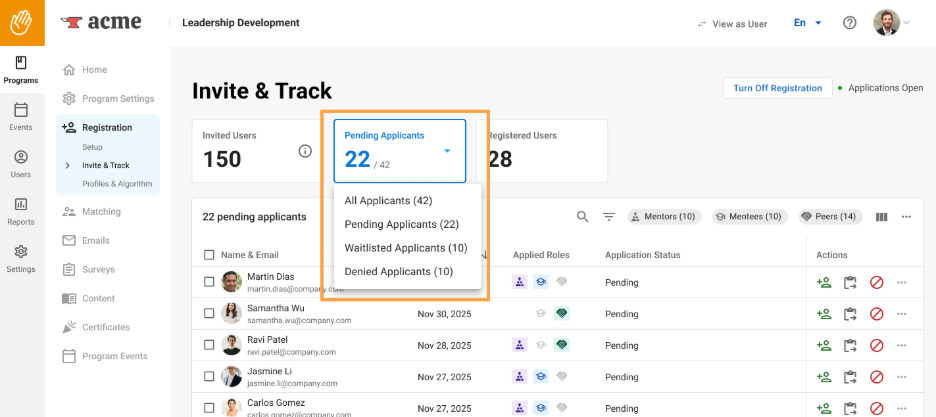
Once applications come in, admins can filter, sort, and review them directly in Together—no spreadsheet required. You can mark applicants as accepted, waitlisted, or rejected, and trigger communications to each group accordingly. If multiple admins are involved in the review process, everyone is working from the same system.
Track demand and re-engage participants in real time
Together surfaces demand analytics so you can see how many people applied relative to your capacity, and use that data to make the case for program expansion. You can also identify participants who were invited but haven’t yet submitted an application, so you can send targeted reminders to that group rather than blasting everyone on your invite list.
For admins running programs that used to require duct-taping together SharePoint, email, and manual uploads, Registration Applications closes a real gap. If you're scaling a mentorship program and need a more structured way to manage intake, we'd love to show you how it works.
Book a demo to see Together's mentorship platform and Registration Applications feature in action.


.jpg)


.svg)