

.svg)
While it’s true much of the work world has changed in a short time frame due to AI and other rapidly advancing tech, one thing has not: the need for humanity. As intelligent tools take over repetitive tasks or accelerate technical ones, the skills that differentiate high performers are deeply human—critical thinking, empathy, adaptability, and leadership.
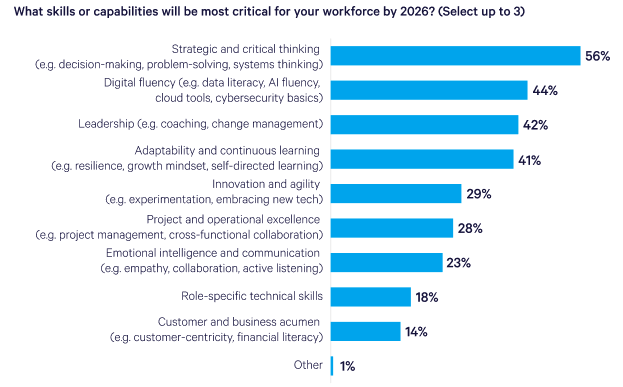
Soft skills in the workplace are now a currency that determines how well employees collaborate, solve problems, make decisions, and adapt to change. In our Enterprise L&D in 2026: Trends and Predictions report, your peers in HR and L&D say that soft skills like strategic and critical thinking (56%), leadership (42%), and adaptability (41%) are going to be crucial for their workforce looking ahead.
Training soft skills is a little more nuanced than more technical training, so let’s dive into what is considered a soft skill, why they’re so important (especially now), and how to develop soft skills in the workplace with some handy examples and strategies—including the power of mentorship and social learning.

What are soft skills in the workplace? Why are they the new power skills?
Soft skills in the workplace refer to the interpersonal, cognitive, and emotional capabilities that influence how people work, communicate, and collaborate with each other. If hard skills are the technical abilities needed to do a job—like coding, budgeting, or data analysis—soft skills are the human abilities that determine how effectively that work gets done. To put it simply:
Soft skills are the behaviors, attitudes, and mindsets that shape how people interact with others, handle challenges, and apply judgment.
Here are some examples of soft skills in the workplace:
- Communication
- Emotional intelligence
- Adaptability
- Critical thinking
- Teamwork and collaboration
- Leadership
- Problem-solving
- Time management
- Creativity
Why are soft skills important in the workplace?
Yes, these skills were important before rapid technological advancement, but now they’ve become even more valuable. With AI taking over a lot of transactional work, employees need to excel at the things machines can’t do: connecting with others, thinking critically, making ethical decisions, and navigating ambiguity.
So, why are soft skills important in the workplace? Because they directly influence culture, productivity, innovation, and the quality of human decisions—especially decisions made with AI.
💡 Learn more about the role of AI in learning and development—and how to balance human with robot
Why are soft skills becoming power skills?
We’re not saying soft skills are replacing technical skills, but they are necessary to enhance them. Soft skills are the foundation of a strong, resilient workforce.
It’s adapt or get left behind
We’ve hit a period of the most rapid technological advancement in history. What that means is a lot of change to adapt to very quickly. Adaptability at work means:
- Adapting ideas to new information
- Experimenting with new tools
- Staying open and curious to change
AI removes busywork but exposes skill gaps
While automation frees employees from manual tasks, it also reveals where teams struggle with:
- Communicating effectively
- Managing conflict
- Making decisions
- Working across functions
Hybrid and cross-functional work demands collaboration
Teams are more dispersed, diverse, and interdependent than ever. Success relies on the ability to:
- Communicate asynchronously
- Interpret tone and nuance in digital communications
- Navigate cultural differences
- Build trust without physical proximity
Leadership has shifted from commanding to coaching
Today’s leaders need to be:
- Empathetic
- Inclusive
- Skilled at giving feedback
- Able to guide teams through change
- Comfortable facilitating rather than directing
AI hallucinations are a thing—making critical thinking non-negotiable
While AI tools are powerful, they’re only as good as the data they’re trained on which could be full of inaccurate data, biases, or overly confident yet incorrect answers. Employees need to know how to:
- Validate AI outputs
- Spot inconsistencies
- Ask the right questions
- Apply context
- Make sound, evidence-backed decisions
The top power skill: Critical thinking in the workplace
Your peers said critical and strategic thinking are going to be the most important skill for their workforce in the year ahead for a good reason.
Critical thinking in the workplace involves evaluating information, analyzing options, asking questions, and making reasoned decisions. Critical thinking is what keeps teams grounded, ethical, and aligned with each other and the company as a whole.
Why is critical thinking important in the workplace today?
- AI often produces outputs that look right but aren’t
- Complex problems require creative, judgment-based thinking
- Teams rely on sound analysis to avoid costly mistakes
Here are some examples of critical thinking in the workplace:
- Noticing when AI-generated information contradicts real-world results
- Challenging assumptions in a project proposal
- Identifying potential risks in a strategy before presenting it
- Asking questions like “what evidence supports this conclusion?”
Another top skill: Leadership
While critical thinking is the top skill HR and L&D see the need for, leadership skills aren’t far behind. In fact, leadership development was listed as their top priority in both 2025 and 2026.
Why are leadership skills such important soft skills? Because the leaders make the company. Let’s look at a 2025 study from Gallup. They found ineffective leadership has far-reaching consequences on engagement, job satisfaction, and overall employee enablement.
- Only 47% of employees strongly agree that they know what is expected of them at work
- Only 31% strongly agree that someone at work encourages their development
- Only 32% feel strongly connected to their organization’s mission or purpose
- Only 28% strongly agree that their opinions count at work
This all comes down to leadership soft skills like effective communication, emotional intelligence, active listening, giving and receiving feedback, change management and employee performance enablement.
How to develop soft skills in the workplace: An L&D toolkit
Developing soft skills isn’t some mystical, ambiguous process. It just requires the right tools, programs, resources, and reinforcement.
This section covers how to develop soft skills in the workplace using different frameworks, implementing training methods, incorporating them into your learning and development strategy, and supporting continuous learning and collaboration.
1. Start with a skills baseline
Before investing in training soft skills, conduct a thorough skills gap analysis to give you a map of where your organization is at now and where it needs to go.
Use tools like:
- Skills assessments
- 360 degree feedback
- Self-reflection surveys
- Behavioral interviews
- Skills taxonomies
2. What is soft skills training?
Soft skills training includes programs, workshops, and activities that teach employees how to communicate, collaborate, think critically, and interact effectively with others.
Here are some soft skills training examples:
- Role-playing scenarios: Role-playing helps practice communication, critical thinking, and conflict resolution.
- Mentorship programs: Mentors help develop emotional intelligence, problem-solving skills, and feedback skills.
- Peer learning circles: Peer learning helps by sharing experiences, creating understanding and trust, and practicing collaboration.
- Microlearning modules: Microlearning gives bite-sized training on specific behaviours like unconscious bias.
- Manager-led workshops: Managers can model effective collaboration and leadership.
- Job shadowing programs: Employees learn by observing others perform their job.
How to teach and reinforce critical thinking
Critical thinking deserves special attention because of how crucial it is in workplaces—especially ones that incorporate AI in any capacity.
Here are examples of critical thinking in the workplace and how to develop those skills in your employees:
- Teaching employees to question information: Encourage them to ask questions like “what evidence supports this?”, “is this source credible?”, “what assumptions are being made?”, or “what alternatives have we considered?”
- Scenario-based learning: Provide real examples of AI mistakes or ambiguous information and have learners analyze the risks and solutions.
- Promoting evidence-based decision-making: Show employees how to use data effectively without relying on it blindly.
- Peer review and cross-team feedback: Ask teams to evaluate each other’s plans or proposals to build analytical thinking and improve quality.
Building leadership competency and readiness
Leadership today looks wildly different than it did even 5-10 years ago. Influenced by hybrid and remote work, technological advancements, and societal change, leaders need to be adaptable, emotionally intelligent, collaborative, and—above all else—human-centered.
Promoting someone doesn’t instantly make them a good leader. They grow through intentional learning experiences.
Here are some leadership soft skills training examples:
- Core leadership behaviors: Focus on skills like communication, giving feedback, conflict resolution, inclusive leadership, and decision-making. Break these into small, practice-ready behaviors employees can apply immediately.
- Scenario-based leadership practice: Give employees leadership moments before they hold leadership titles through scenarios that simulate common challenges.
- Leadership development pathways: Offer structured opportunities that build leadership skills gradually—accessible to employees of all levels.
- Mentorship for leadership growth: Mentors can coach emerging leaders on real challenges, help refine communication skills, and provide feedback.
- Leadership in everyday work: Encourage team members to lead meetings, facilitate discussions, or manage small projects.
Measuring soft skills development
Measuring soft skills training can be a little trickier than technical skills. There’s no one skill assessment that can quantify behavioral aptitude. But, you can evaluate growth using a mix of qualitative and quantitative methods:
- Behavioral observations: Track changes in how employees collaborate, communicate, and problem solve in practice.
- Manager and peer feedback: Use structured forms like a 360 feedback template to gather insights on progress and consistency.
- Self-assessments: Encourage employees to reflect on their strengths, confidence levels, and areas for improvement.
- Practical assessments: Evaluate performance in role-plays, simulations, presentations, and team activities.
- Goal tracking: Set clear competency targets and monitor progress over time through development plans (i.e. a leadership development program)
Training soft skills through mentorship and social learning
Soft skills are human skills and the best way to develop them is through other humans. Mentorship programs and other programs that rely on social learning create natural environments where employees observe, model, practice, and reinforce soft skills in real time.
Why mentorship and social learning works so well for soft skills training
Talking about mentorship and social learning in this context, we mean:
- Traditional one-on-one mentorship
- Group mentoring
- Peer mentoring
- Job shadowing program
- Employee resource groups (ERGs)
Working with other people in a learning context can provide:
- Real-world examples of soft skills in action
- Safe spaces to practice new behaviors
- Feedback from someone who’s been in similar situations
- Emotional support during career challenges
- Improved confidence and communication
For example, a mentor can help a mentee practice difficult conversations, work through decision-making dilemmas, or talk through conflicts.
Mentorship and social learning is effective because, while AI can teach you what soft skills are, only people can teach you how soft skills feel. Mentorship adds the human dimension that’s missing from digital training.
Soft skills in the workplace are your competitive edge
The workplace may be changing fast, but one thing is increasingly clear: your organization’s greatest competitive advantage isn’t technology—it’s people. Sure, AI can draft emails, analyze data, and assist with tasks, but only humans can communicate with empathy, lead with integrity, collaborate effectively, and think critically.
Soft skills in the workplace determine whether teams thrive or struggle, whether change feels exciting or overwhelming, and whether technology becomes an accelerator or a liability.
As we said before, the best way to build human skills is through other people and Together can help you do that. Our mentorship platform intelligently matches participants based on meaningful criteria and provides the flexibility to configure your program how your employees need it—whether it’s a leadership development program, job shadowing, peer learning, or anything else you need.
Ready to get started? Book a demo with one of Together’s experts to start training soft skills through mentorship.







.svg)