

.svg)
Your new hires don’t necessarily need a parade or fireworks to welcome them to the team (especially since those things could be pretty distracting in a typical office environment!), but they do want to feel welcomed, treated with respect, and set up to succeed in their new role. That means more than simply ensuring their paperwork is taken care of and they have the equipment they’ll need to get started—those are just the bare minimum.
And with only 12% of employees agreeing their company does a great job of onboarding, there’s a big gap here that many companies have yet to bridge.
If you’re looking to go above and beyond with your company’s onboarding, we’ve collected several examples of the best employee onboarding programs. Feel free to adopt whatever ideas you find here or adapt them to your specific company culture.
8 examples of the best employee onboarding programs
Let’s jump right in! Here are eight examples of companies with successful onboarding programs. As you read through these, think about which ones you’d like to steal or use as inspiration for your own program.
1. Cooley
Cooley is an American international law firm, headquartered in Palo Alto, California, with offices worldwide. Their onboarding process is crucial because the nature of their work requires new employees to ramp up quickly.
To get new hires up to speed, they started an onboarding mentorship program called Cooley Academy Mentoring Program (CAMP), which pairs new employees with more senior associates.
During the program, mentors and mentees meet each month. They discuss goal setting, delegation, career development, and more. New hire mentees are able to:
- Get outside support from senior staff and ask questions from someone other than their work friends and manager.
- Expand their professional network and meet others from diverse groups.
- Learn by example from the real stories of leaders who have built their careers and achieved ambitious goals.
- Find others from like-minded groups and foster relationships at their organization.
One way Cooley customized their mentorship program was to kickstart a competitive “mentoring madness” challenge where attorneys had three weeks to “compete” to be the best mentoring duo in the office by completing weekly challenges. Attorneys gained points for accomplishing mentoring milestones such as:
- Talk to your mentor about your personal brand
- Give your mentee advice on internal networking
- Arrange a shadowing opportunity for your mentee
- Share your thoughts on what work/life balance means to you
For new employees going through onboarding, it can be a daunting experience to join a new company. Having a mentor to guide them through joining a large law firm made the transition more supportive and shortened the ramp-up time. Cooley’s onboarding mentoring program quickly got off the ground and provided the benefits of mentorship to all their new hires.
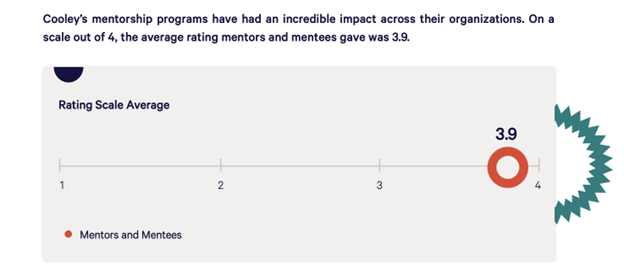
And the results are clear: On a scale of 1 to 4, the average rating both mentors and mentees gave of their experience was 3.9.
2. The Access Group
The Access Group provides business management software to more than 100,000 organizations globally. With over 8,000 employees worldwide, the company’s workforce spans offices in the UK, Europe, USA, and Asia-Pacific, along with operations centers in Romania and Malaysia.
The Access Group completes many acquisitions each year, ranging from smaller startups to larger organizations of up to 400 people. The company works hard to give acquired employees an excellent integration experience. But faced with a new culture and ways of working, these colleagues need help to find their feet and make connections in their first few weeks and months. And that’s where the buddy program comes into play.
“As newly acquired colleagues take their first steps into Access, there’s a lot for them to get their heads around,” explained Tony Wittmann, Head of Employee Success, Acquisitions and Change at The Access Group. “New systems to navigate, new people to meet—and a whole new culture to dive into. The buddy program allows well-established colleagues to wrap a virtual arm around these new team members and help them settle into their new Access world. With the support of their buddy, this new world just doesn’t feel as scary. ”
Instead of wondering how to find their way around, new colleagues feel instantly connected and engaged. By giving them an inside source for questions, tips, and insights into company culture, the buddy program facilitates the employee integration process.
And feedback from buddy program participants shows just how much they value the experience. “We spend a lot of time listening to colleagues who join from acquisitions to understand the support they need as they become part of Access. They tell us the buddy program helps them get up to speed with new ways of working, bridging the gap between the old world and the new,” said Tony.
3. Wellabe
Leading insurance company Wellabe has made mentorship a cornerstone of its employee development strategy, especially when it comes to welcoming new hires to the organization.
Here’s how Senior Learning & Development Specialist Joey Spivey describes Wellabe’s mentorship philosophy: “The biggest value of mentoring is that it provides hyper-personalized development at scale.”
Wellabe launched Culture Colleagues, a 90-day onboarding mentorship experience that pairs new hires with seasoned employees to support integration and cultural alignment.
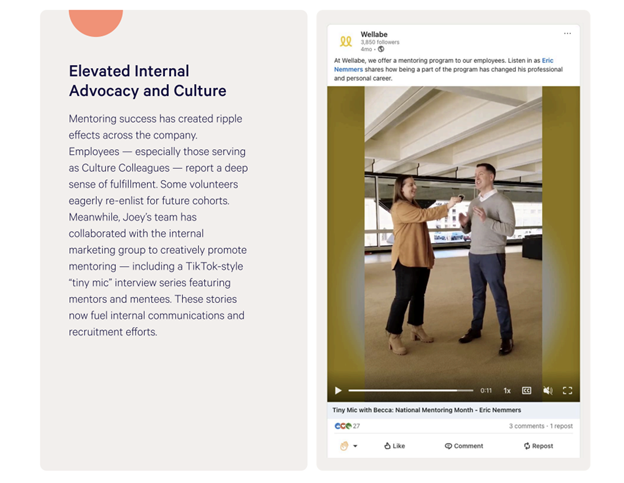
The success of the program became clear as the participants acting as Culture Colleagues reported a deep sense of fulfillment and volunteered to participate in future cohorts. At the same time, onboarding surveys began to reflect deeper, more enthusiastic comments about new hires’ relationships and their support systems. One new hire described the culture as “a breath of fresh air… I’ve never experienced anything like it.”
4. When I Work
Minneapolis-based scheduling and workforce management software company When I Work faced a significant challenge when the company shifted to remote work. Bringing their customer-facing new hires up to speed via Zoom was ineffective and time-consuming, especially given the frequency of their product updates.
Here’s how Training Manager Jenny Roselyn described their situation: “Our customer-facing teams are product experts, and we needed a way to reduce cost and ramp-up time, as well as effectively communicate and teach about product updates so they felt prepared to inform and help customers.”
The When I Work team decided to overhaul their new hire onboarding to focus on training. But here’s the key: They wanted to empower new hires to engage with training materials when it made sense to them—not when it was dictated by a training calendar. And Absorb LMS helped make this a reality.
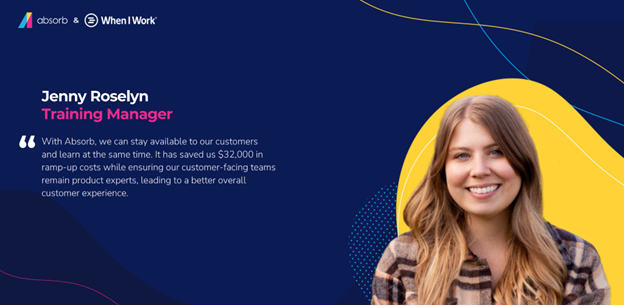
The self-serve approach to training materials meant that they could accelerate new hires’ ramp-up time and offer more personalized guidance. Plus, they reduced the amount of money they were spending on ramping up members of the Customer Care team—a huge win for the company.
Shifting from Zoom onboarding to on-demand self-serve content helped When I Work successfully hire and train more than 20 Customer Care agents over a two-year period, all without sacrificing ramp-up time, customer satisfaction, product knowledge, or team culture.
5. Buffer
Social media scheduling tool Buffer has an all-distributed workforce, which poses plenty of challenges in terms of onboarding new hires and creating a cohesive company culture.
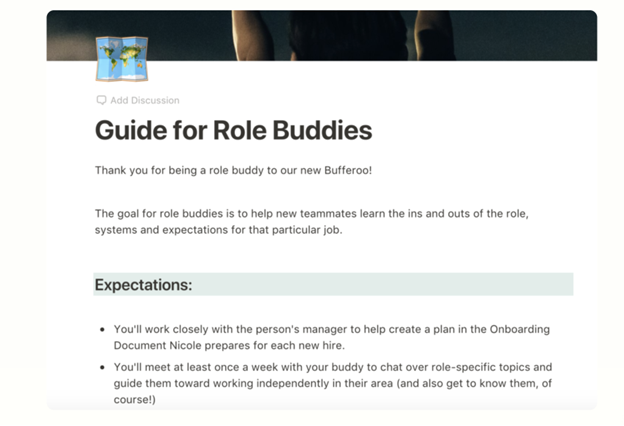
While the new hire’s manager plays a critical role in the onboarding process, Buffer also assigns different buddies to fulfill different roles.
For example, the role buddy is usually a peer who works on the same team as the new hire or in a comparable role somewhere else in the company. Role buddies usually meet with new hires once or twice a week and are available to answer questions about the new hire’s role or tasks.
Buffer also assigns new hires a culture buddy. This person is generally on a different team and their role is to provide context on company history and norms. They tend to meet with new hires weekly in their first few weeks, and then on an as-needed basis.
Buffer’s Director of People Nicole Miller writes about the role of culture buddies as coaches: “In our latest evolution, we put a particular emphasis on our Culture Buddies knowing how to give both coaching (advice designed to help teammates grow and advance) and corrective feedback (which points out a needed change to make).”
6. Airbnb
Online short-term rental and experience booking site Airbnb is powered by technology, so onboarding technical hires like engineers and data scientists is especially critical to the company’s success.
Beti Gathegi, former Senior Program Manager of Technical Education at Airbnb, wrote about how the company approached “Bootcamp,” their term for onboarding engineers and other technical hires.
The core of Bootcamp at Airbnb involves pairing new hires with more tenured employees. Beti wrote, “We pair each new hire with a buddy from their team. They serve both to scope the hire’s starter project as well as to answer the many questions that inevitably pop up in onboarding.”
Beti explained that volunteers from different teams raise their hands to host different Bootcamp sessions. “Most of them are driven by providing a sense of belonging,” she wrote.
Beti emphasized that this sense of belonging is one of the core values that drives Airbnb’s approach to onboarding: “Beyond the technical parts of onboarding, Bootcamp plays a critical role in setting Airbnb’s culture. Especially in a remote work environment, the quality of onboarding can make or break whether new hires feel a sense of community and feel comfortable engaging with it themselves. We emphasize belonging and inclusivity as core values of our culture, and we welcome new hires to bring their own special qualities to integrate into our ever-evolving culture.”
7. Figma
Collaboration is built into the DNA of design tool Figma, so it’s only natural that the company would want to highlight collaboration during their new hire onboarding process. Leadership coach James Bruce described how the company recently revamped their new hire onboarding. It all started with getting leadership buy-in to send the message that executives believe in the importance of onboarding and “it’s not just HR’s job.”
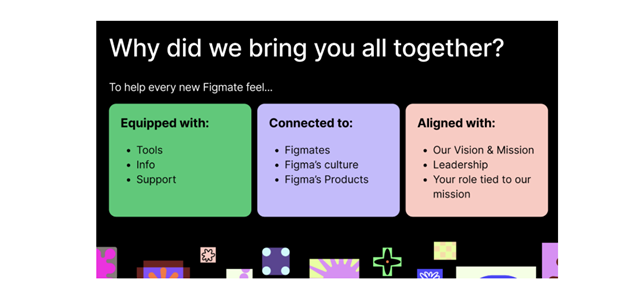
James describes how Figma also considered new hires’ specific needs during this process, writing, “We designed the program around a kind of Maslow’s hierarchy of needs, but for onboarding.”
The three levels of needs were:
- Equipped: New hires first need to be equipped: the tools, the support, and the information they need to succeed.
- Connected: Once equipped, they need connection to their cohort, to Figma’s culture, to the products (all eight of them), and to the broader Figma community.
- Aligned: Finally, alignment with the mission and vision, with leadership, and with how their individual role ties to the larger impact.
One of the ways they made this happen was by weaving coaching principles throughout the experience. “We didn’t just deliver content. We asked each cohort what success would look like for them, and we adjusted in real time,” writes James.
And for a creative company like Figma, giving employees time for reflection and journaling is also a critical part of new hire onboarding: “We invited new hires to pause and think about what they want this next chapter of their work and life to mean.”
8. Zapier
Automation company Zapier has given a lot of thought to how they approach onboarding their fully remote workforce. Zapier’s Onboarding Program Manager Ashley Priebe Brown, Senior People Ops Generalist Savannah Waggoner, Onboarding Specialist Randy Alvarenga, and Learning & Development manager Dara Hashemi shared their thoughts on employee onboarding best practices.
In addition to setting clear expectations (and timeframes for achieving specific goals) and providing access to resources, Zapier emphasizes relationships and interpersonal connections during new hire onboarding. They describe their aim in this way: “Foster an environment where new hires can build connections across the organization. Ensure they know who to connect with and why, and share the team's culture on connecting. This creates a sense of belonging and support within the company.”
There are several ways Zapier encourages new hires to build relationships through a buddy program called “Zap Pals.” The onboarding team explains, “We pair new hires with veteran employees who can act as friendly resources, guides, and familiar faces. This fosters a sense of belonging and support within the company.”
Zapier also relies on veteran team members to model the company’s values. The onboarding team explains, “New teammates interact with experienced Zapiens who demonstrate our values daily, setting a standard for how we work and illustrating the importance of these values in our company culture.”
So what exactly makes a successful onboarding program?
Now that we’ve reviewed 8 real-life examples of successful onboarding programs, what do these initiatives have in common? In other words: What are those critical elements that make an onboarding program successful?
There’s no single right answer—it’s something you’ll need to define for yourself—but here are a few common goals or objectives for new hire onboarding:
- To integrate new employees with your company's culture and standards.
- To increase the chances that new hires will be successful on the job with little or no supervision.
- To support new employees in reaching set onboarding goals (such as becoming familiar with specific processes or achieving work milestones).
- To help new hires establish a good rapport with their colleagues.
- To give new employees a strong understanding of their role and responsibilities.
- To boost the new hire’s trust and confidence in your company, which ultimately leads to longer tenure and more engaged, high-performing employees.
Taking the time to define your onboarding program’s goal or objectives will help give you concrete data to determine how successful it really is.
And if you’re looking for more guidance on what types of things to measure, we’ve got you! Here at Together, we recommend a multi-level measurement framework.
Level 1: Reaction and satisfaction
- Participant satisfaction scores
- Net Promoter Score (How likely are new hires to recommend your company to someone else?)
- Completion rates and engagement metrics
Level 2: Learning and skill development
- Pre/post onboarding program competency assessments
- 360-degree feedback improvements
- Goal achievement rates
Level 3: Behavior change and application
- Manager effectiveness ratings
- Self-reported confidence increases
Level 4: Business results and impact
- Internal promotion rates
- Retention improvements
- Team performance metrics
You can dive even deeper into how to measure onboarding program success here.
The best employee onboarding features onboarding buddies or mentors—and what this means for you
You can see that successful employee onboarding programs span different industries, locations, and company sizes. But one characteristic they all tend to share? They personalize onboarding and help new hires build relationships through onboarding buddies or mentors.
Keep in mind that mentors don’t necessarily need to come from the upper ranks of your company to be effective onboarding buddies. Here at Together, we surveyed employees from 50+ leading North American companies and found that in their first six months, 70% of employees wanted a mentor or peer who was closer to their tenure. Survey respondents shared that “a junior mentor is super useful at the beginning to ask all the stupid questions.”
The specifics can vary from company to company, but here are a few of the most common ways onboarding buddies get involved:
- They meet new hires on their first day (either in person or virtually) for a quick check-in
- They bridge social connections by introducing new hires to other employees
- They answer new hires’ questions about the role and company
- They give the new hires a tour of the office and help them understand workplace norms
- They check in with new hires throughout their first month to help them feel more comfortable and integrated into the company culture
These tasks don’t require a lot of extra time or investment—and they’re certainly not as disruptive as fireworks or a parade—but they can completely transform a new hire’s experience.
Looking for more guidance on how to integrate onboarding buddies and mentorship into your own onboarding program? Download the Onboarding Mentorship Program ebook to get advice on how to plan, launch, and measure the success of your onboarding buddy program.
FAQs
What are the key components of a successful onboarding program?
While the specifics of onboarding programs can vary a lot by company, most successful onboarding programs include several core components: clear communication of the new hire’s role expectations and responsibilities, opportunities for the new hire to be integrated into your company's culture and values, access to the resources and tools new hires need to do their job, and opportunities for new hires to build relationships with colleagues. The best onboarding programs also set measurable goals and check in on new hires' progress at regular intervals. As the examples in this article show, pairing new hires with an onboarding buddy or mentor can tie all of these components together by giving them a dedicated person to turn to for guidance and support.
How long should an employee onboarding program last?
While some companies limit onboarding to the first week or two, the most effective programs extend much longer. Many of the examples in this article span 90 days or more. Onboarding tends to be more hands-on and involved during a new hire’s first 30 days and touch points can be shorter and more spaced out during the later phases.
What is an onboarding buddy and why does it matter?
An onboarding buddy is a current employee who's paired with a new hire to help them navigate their first weeks and months at the company. Buddies typically handle things like introducing new hires to other team members, answering questions about workplace norms and culture, and checking in regularly to make sure the new hire feels supported. Onboarding buddies are especially helpful because they give new hires a go-to person to answer their questions in addition to their manager (and many new hires admit they feel less embarrassed to ask “stupid” questions of their onboarding buddy than they would with their manager). Getting all their questions answered and not keeping things to themselves means new hires can ramp up faster, feel a stronger sense of belonging, and stay with your company longer.
How do you measure the success of an onboarding program?
You can measure onboarding success at multiple levels. Start with new hire satisfaction surveys and completion rates, then look at competency assessments and goal achievement. Over time, track behavior changes like manager effectiveness ratings and self-reported confidence. Ultimately, the business impact shows up in metrics like retention rates, internal promotions, and team performance. Together recommends a multi-level measurement framework to help you get the full picture.







.svg)